
Why is my piano making clicking noises?
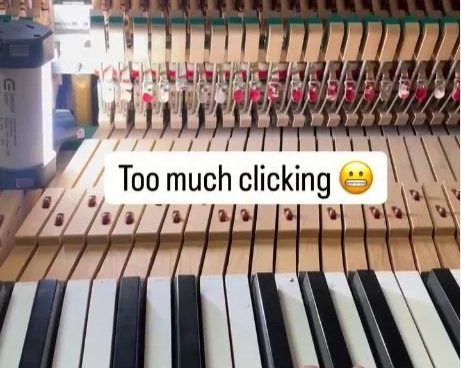
Piano clicking repair
If you’ve ever owned a piano for more than a few years, you’ve probably noticed that little issues tend to crop up over time. Maybe a key starts to stick, a pedal squeaks, or an unexpected noise appears where there wasn’t one before. This is completely normal — and it has everything to do with how pianos are built.
Pianos are complex mechanical instruments made largely from organic materials: wood, felt, cloth, leather, and glue. These materials are sensitive to their environment. Changes in temperature and humidity (like the seasonal changes we experience in DC, MD, and VA) cause them to expand and contract. Normal playing gradually wears contact points. The result? Small mechanical shifts that sometimes announce themselves as clicks, rattles, or buzzes.
Extraneous piano noises are one of the most common concerns we hear from piano owners. And understandably so — when you sit down to play, the last thing you want is an annoying click distracting you from your practice. The good news is that not every noise indicates a major problem. In many cases, the fix is relatively simple once the source is properly identified.
A good example of this came up recently during a tuning at a church in Alexandria, Virginia. The piano had developed several distracting clicking noises. After a careful inspection, the cause turned out to be straightforward: a couple dozen screws had loosened over time.
Inside a piano, there are hundreds of screws securing action parts, brackets, pedals, and case parts. These screws are designed to hold things firmly in place, but seasonal humidity changes can cause them to back out slightly. When that happens, even a tiny amount of movement can create audible noise.
In this case, simply tightening the appropriate screws eliminated the unwanted sounds entirely. No replacement parts were needed, no major regulation work was required, and the piano was back to playing quietly and reliably. It’s a simple fix that can be handled during a standard tuning — but only if you know where to look.
The short video above shows the fix in action and gives a behind-the-scenes look at how these noises are diagnosed and resolved. It’s a good reminder that many piano issues aren’t dramatic failures, but rather the cumulative effects of time, use, and environment.
If your piano is making clicks, buzzes, or other unfamiliar sounds, it doesn’t necessarily mean something is seriously wrong—but it does mean it’s time to have it looked at. Much like a car, addressing small issues early often prevents larger, more expensive repairs down the road, and keeps your instrument playing the way it should.
Pianos are built to last generations, but like any finely crafted machine, they need occasional attention. Sometimes, the solution really is as simple as tightening a few screws.